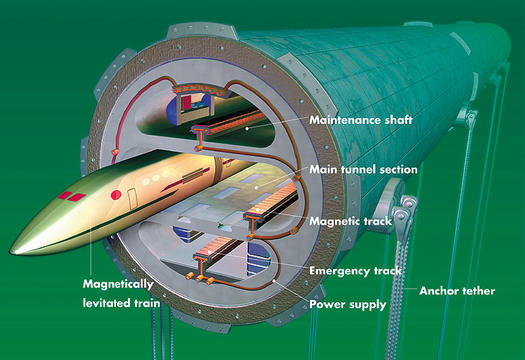
Imagine boarding a train in London and arriving in New York less than an hour later. Sound too good to be true? This could soon become a reality thanks to something called a “vacuum tube train”. The idea is to take existing maglev technology – which involves using electromagnets to propel a train along a track which it never actually touches – and embed it inside an airless tube to eliminate air resistance. This will allow speeds of over 5,000 mph to be achieved and finally make super-fast intercontinental travel possible.
Maglev technology has been around for decades but the first commercial high-speed line didn’t open until 2004. This line runs for 19 miles between Shanghai and Pudong International Airport and reaches a nippy 268 mph, making the full journey in just 7 minutes. A much longer route is currently under construction in Japan and will link the capital Tokyo with the cities of Nagoya and Osaka by 2027 and 2045 respectively.
There are many advantages of maglev over conventional high-speed rail. First of all, a maglev system requires a lot less maintenance due to the fact that the train floats above the track. A normal train must have parts replaced every few months due to general wear and tear and tracks must be replaced every couple of decades due to frictional degradation. Maglev trains on the other hand have a much longer maintenance schedule due to having no moving parts and their tracks can last much longer as they are never actually in contact with the train.
Secondly, maglevs are a lot safer than conventional trains for a number of reasons. As maglev trains only float a few millimetres above the track, any loss of power would result in the train simply dropping onto the track meaning a derailment is impossible. Also, as all of the trains are controlled by a central computer system, collision avoidance systems can be used to eliminate human error and prevent two trains ever colliding.
Thirdly, maglev trains are much more power efficient than conventional trains as they only require energy to overcome air resistance instead of a combination of air resistance and frictional resistance between the train and the track. This, combined with the fact that they are powered by electricity instead of fossil fuels mean that maglev trains are much better for the environment than any other current form of transport.
 Fractalis - An ongoing journal