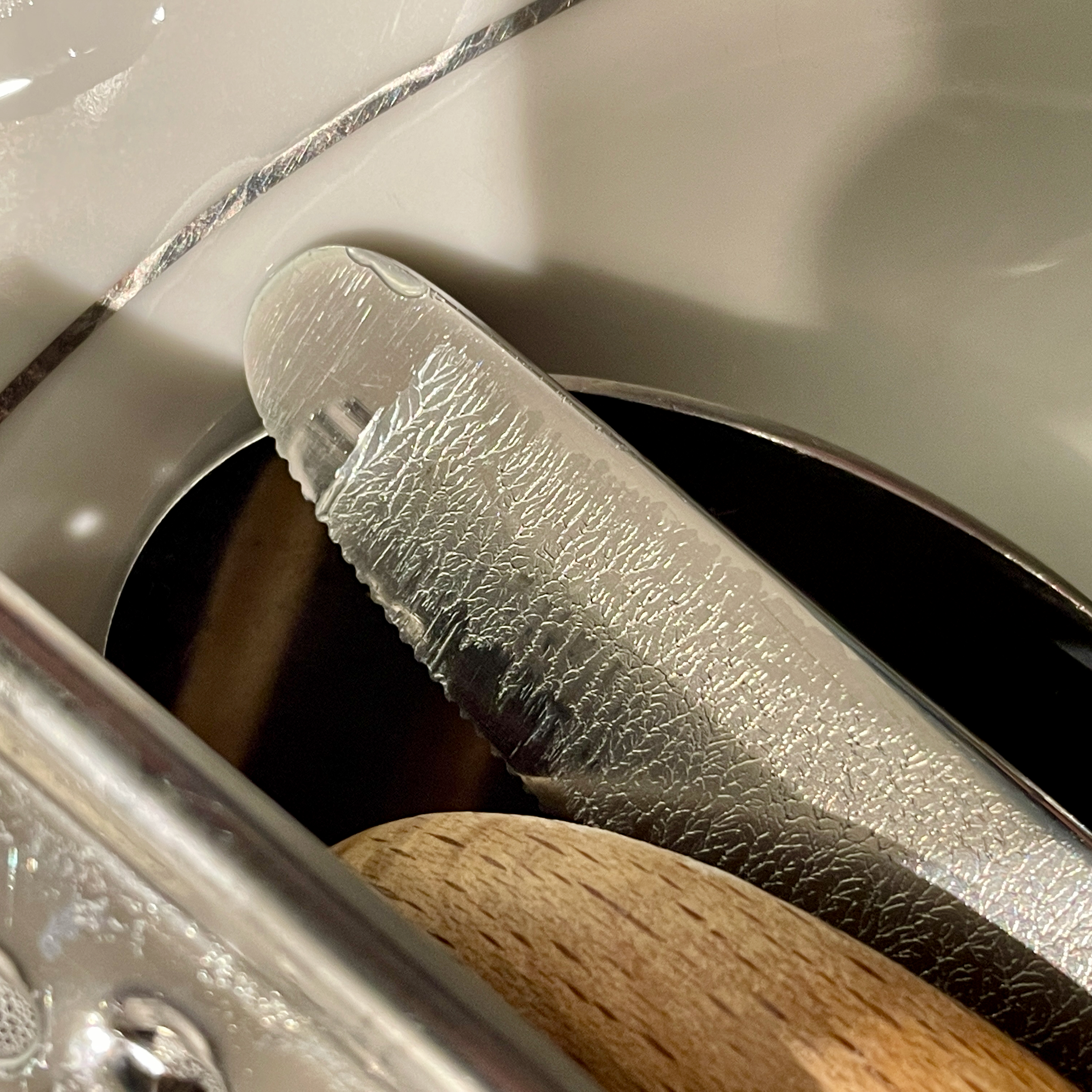
The universe decided to gift me with a wonderful fractal pattern when I cut into a block of butter with this knife.
The universe decided to gift me with a wonderful fractal pattern when I cut into a block of butter with this knife.

There’s an American word I’ve always disliked which is the word fix, in the sense of just making a problem disappear. “The only way we’re going to fix this is blah blah blah”: this way of thinking is just general. The world actually can’t be fixed.
All Year Zero experiments fail dramatically, whether we’re talking about Cambodia, or we’re talking about the French revolution, or the Soviet Socialist Republics, or China. You can’t go back to Year Zero, you can’t kill your way out of the problem of living. I don’t like the word fix even in its lesser forms, it makes me uncomfortable. The once and for all fix: there is no once and for all fix for anything.
The word I like is the word “repair”: more tentative, more humble. Actually, repair sounds to me like a word that has been feminized because we think of somebody stitching, somebody weaving, somebody making something carefully with their hands and making do. The marines go in there to fix things, they don’t go in there to repair things. Repair can always be undone. I’m thinking of Penelope, unweaving what she has woven, weaving and unweaving. The provisional character of repair, I would say, is where I try to center my thinking. This is not a quietist view of the world, I’m not saying we shouldn’t do anything. We should do something: we should be repairing.
But what does repair look like? There are ever expanding circles of responsibility and care from wherever we’re located. We have responsibilities to the people closest to us. Those of us who work in image-making, broadcasting, and writing have discursive responsibilities that go beyond the people in our immediate household or circle of friends. Because of social media now, very, very many people are in the role of broadcasting, and the responsibility of repair is actually larger now because we can reach larger groups of people. We’re always going to have these horrifying problems with us. That’s not an attitude of defeat. We can ameliorate some of them, that’s the work, it’s like individual work that then gradually becomes collective work.
-Teju Cole, Between the Covers Podcast
Teju Cole remains an incredible source of strength and inspiration. The way he slowly, carefully chooses the words he speaks is truly beautiful to hear. He’s not a person who simply engages verbal flow, the precision with which he communicates hints at a divine, effortless control over his own psyche.
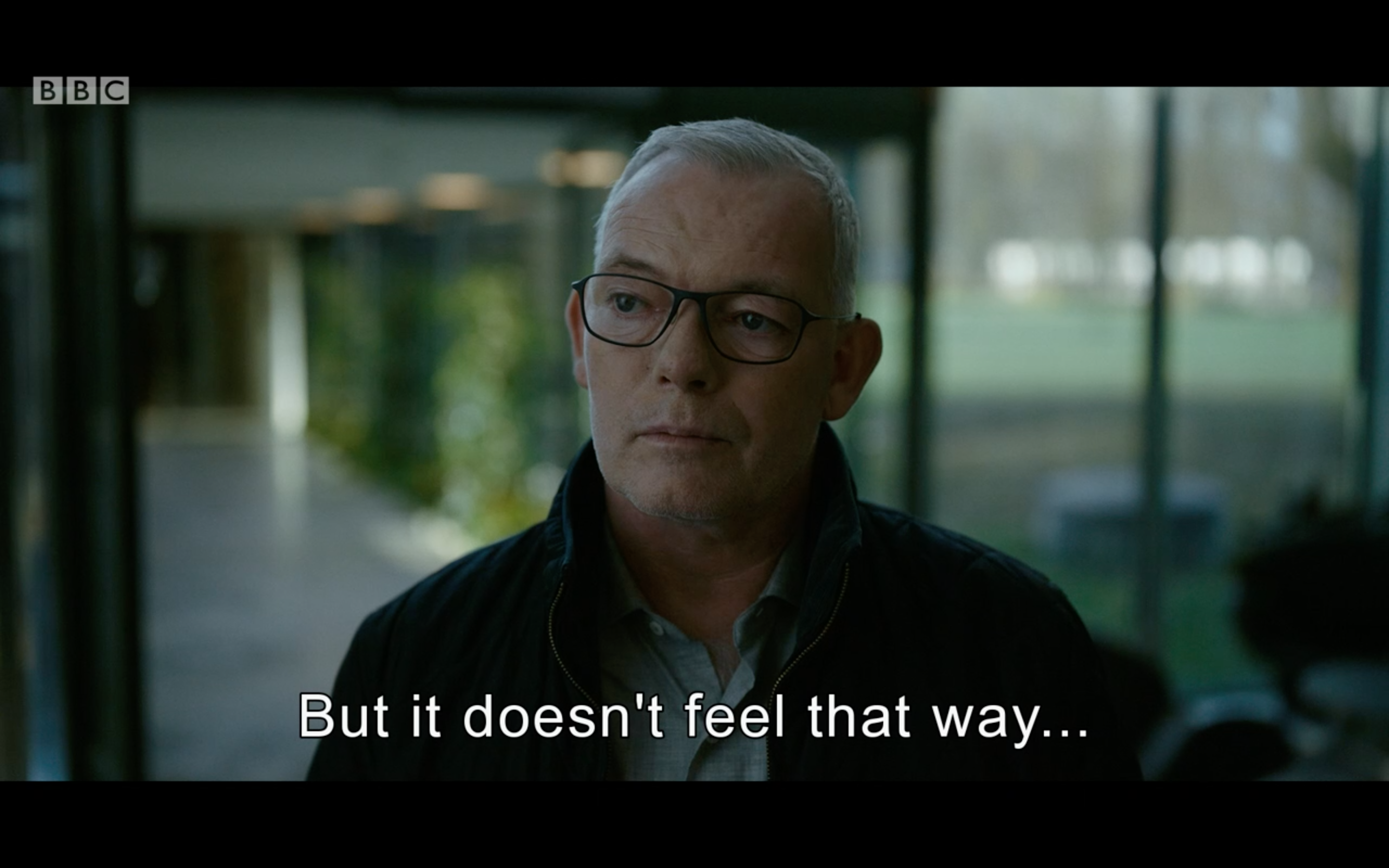
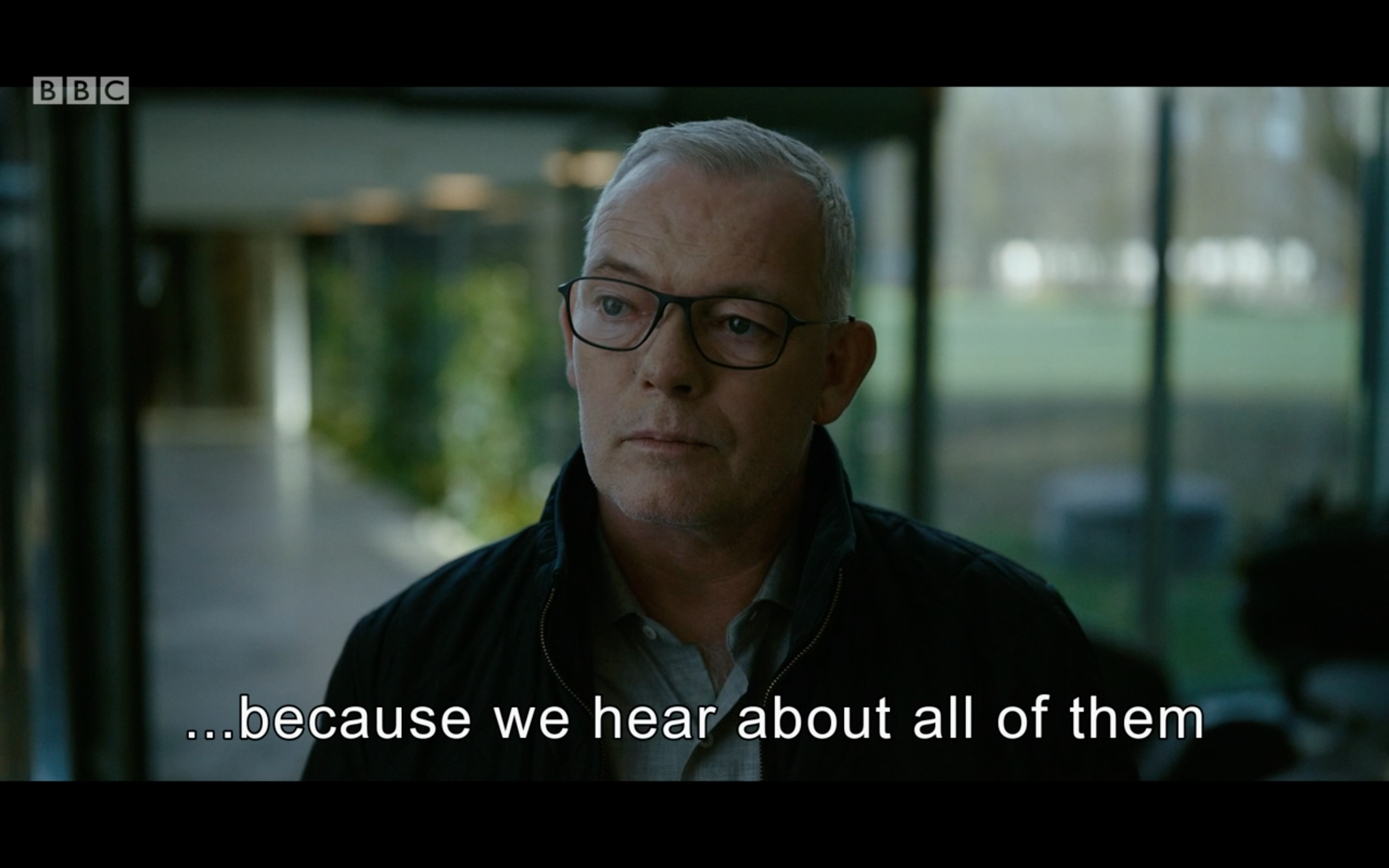
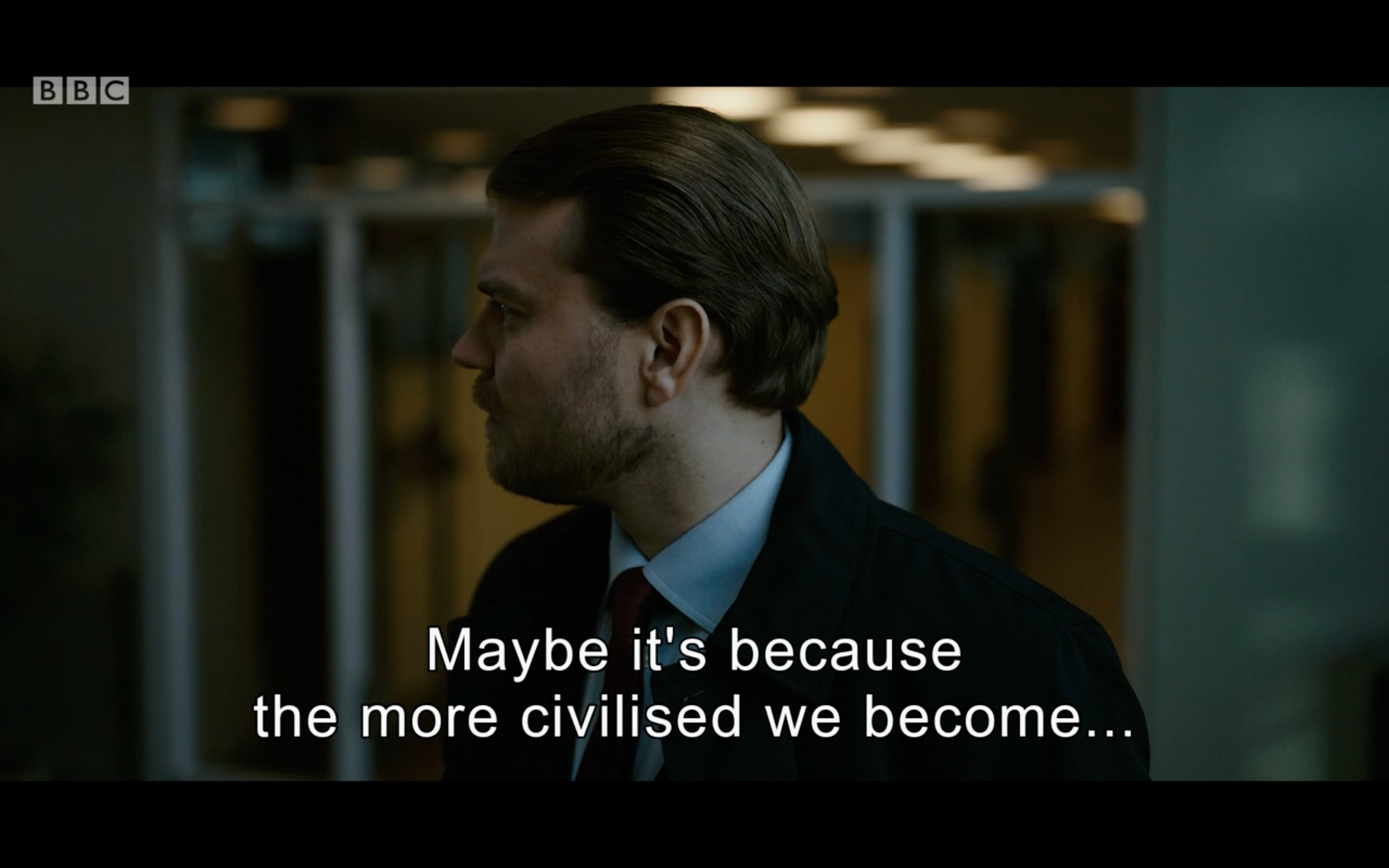
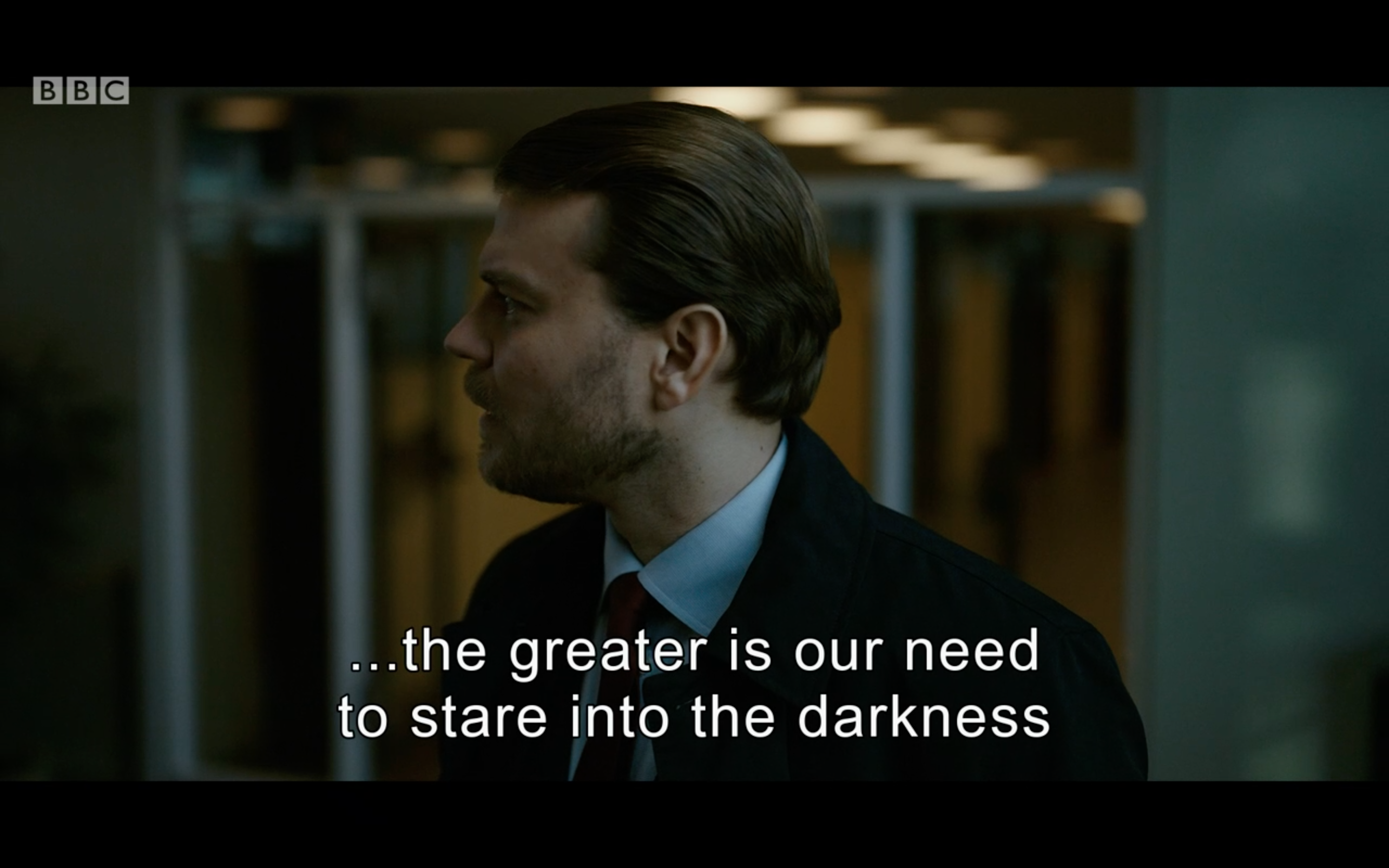
The Investigation SE1EP6
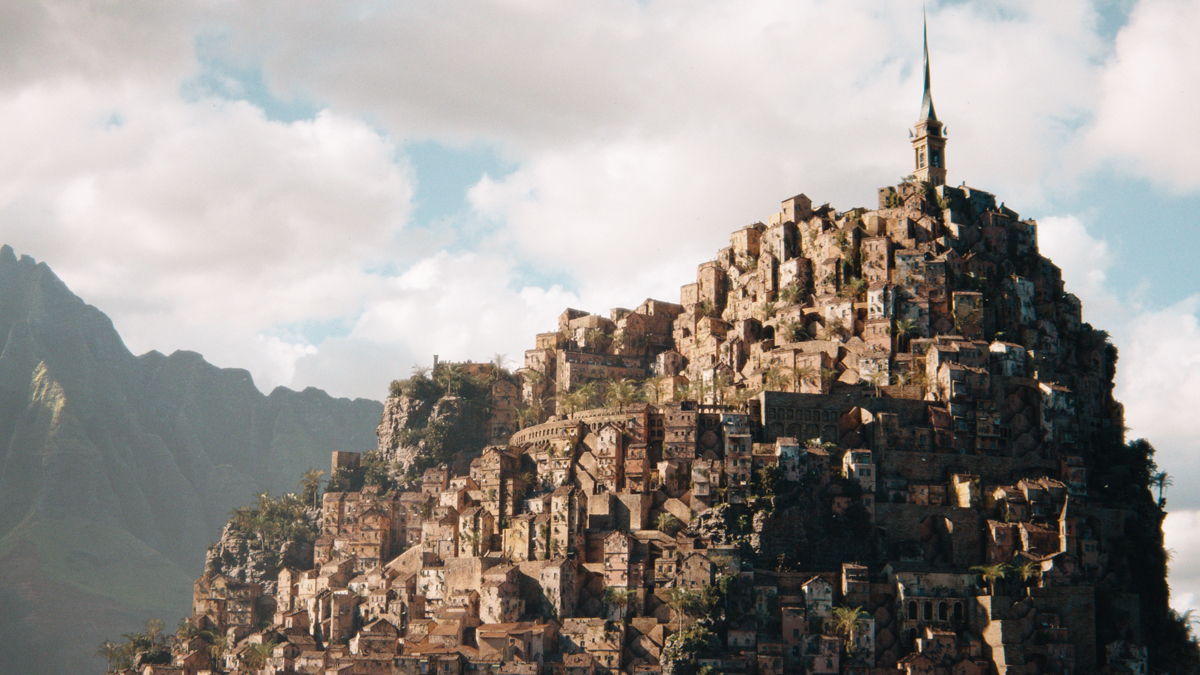
“Well, this was a mercantile city. A city of traders and bankers. We thought we knew about bonds. We thought a bond was something negotiable, something that could be bought and sold and exchanged and converted…But about these bonds, we were wrong. We undid them, and we let the Spectres in.“
Giacomo Paradisi to Will Parry about Cittàgaze
My ears joined the conversation as Jim (a smartly dressed, enthusiastic but downbeat guy who clearly struggles with the hand he has been dealt in life) casually tells Craig (a fast-talking support worker who appears to be trying to help Jim improve his lot) that he hasn’t got any electricity in his home for the next ten days until he receives his next benefit payment.
Craig is clearly shocked by this revelation and spends the following twenty minutes on a verbal investigative hunt in an attempt to ascertain; firstly how Jim is going to survive the next ten days without the key source of energy that is so important in todays world, and secondly why, having helped Jim through a budgeting process previously, he can’t afford to pay his electricity bill.
Jim seems frighteningly nonchalant about being without power for a while, leading me to think this isn’t the first time he has found himself in this situation.
“It’s alright, I can listen to my radio” he says.
Craig asks how he will power his radio without any electricity.
“Batteries, you see” Jim informs him.
“Don’t you have food in your fridge” inquires Craig.
“Yep, I’ve got chicken, and I’ve got turkey” replies Jim, clearly thinking that Craig is inquiring about his ability to buy food and nourish himself.
“But how will you stop the chicken and turkey going off if you haven’t got electricity?”
“I know, it goes off quicker this time of year when it’s hot outside doesn’t it?”
Craig sounds stunned. Unable to get a logical answer, he tries a different tack. “How come you haven’t got any money left to pay your electricity bill?”
“I don’t know, I’ve only got £20 left to last me until next week” says Jim.
Craig decides to do a basic budget for Jim there and then. He asks him exactly how much he gets from his Universal Credit payment and then proceeds to ask him to list his outgoings; rent, council tax, electricity, gas, water, television license. Then how much he spends at the shops each week on food and other sundries. His total outgoings still leave Jim with about £80 a month spare.
“So where is the rest going?” asks Craig, sounding resigned to not receiving a straight answer by this point.
Craig must have asked him a dozen times where the rest of his money is going and Jim, bless him, answers every single time, totally innocently, that he does not know.
“Do you drink?”
“No, not any more” says Jim.
“Do you smoke?”
Jim says he does. Craig asks him how many and receives the response of twenty to twenty five per week.
“But I know a place on the Dudley Road where I can get them cheap, for £3 a pack” Jim quickly adds.
“But that still doesn’t make up the shortfall in your budget” Craig states.
“Do you like to go anywhere else on the Dudley Road?” asks Craig.
“Yeah, the chippy.”
It’s at this point that Jim admits he has a tab at his local chip shop.
“It’s ok though because I know the owner and he gives me a discount.”
“Ok. How much do you have on your tab at the moment Jim?”
“£47. But it’s ok because I’ll pay it all off next week when I get my benefits.”
“So how often do you go to the chip shop?” Craig asks, thinking he might finally be getting somewhere.
“Usually about five or six times a week.”
“And how much do you usually spend when you go there?”
“Maybe four or five pound” Jim replies.
“So that’s £120 a month mate. That’s where all your money’s going.”
“Oh yeah, I suppose it is.” Jim admits innocently.
**The names in this account have been changed to preserve the privacy of those involved.

Melvyn Bragg recently gave a lecture at the Cheltenham Literature Festival about his intriguing new book Love Without End: A Story of Heloise and Abelard about the life of radical twelfth century scholars Héloïse and Peter Abelard. Afterwards, a member of the audience asked Bragg if he knew what had happened to their son Astrolabe. In response he stated that he did not, and he believed that it would take a trained historian who could speak multiple European languages around five years to acquire sufficient information from the archives, libraries and human minds of the world to piece together the life of Astrolabe.
In a world of ubiquitous global internet, Wikipedia, and totally unprecedented access to knowledge for the average person, it’s a somewhat sobering thought to realise that real Truth is still so hard to access.
Bragg is not suggesting that the life experiences of Astrolabe are unknowable, he is merely saying that such knowledge is hidden away in places that require vast amounts of time to discover.
In other words, the Truth is out there for those who are determined to seek it out, but the internet has not provided us with the panacea of Truth-discovery we sometimes think it has and it will take much more time and effort than most people are willing to dedicate in order to reveal real unmitigated Truth.

I saw this meme floating around on Twitter recently shortly after the Prime Minister lost yet another major vote in the House of Commons, this time on a hastily tabled timetabling motion for his Withdrawal Agreement Bill.
While I can, in principle, get behind the idea of shovelling industrial levels of excrement down the gullet of the leader of one of the most heartless and dangerous political parties of the 21st century, I also feel that publicly shaming a politician in such a way will ultimately do society no favours.
Anyone who bothers to study the lessons that history passes down to us will see that, in general, punishing people for perceived wrong-doing never produces a desirable outcome in the end, no matter if it’s a neighbour or the Prime Minster of a government you happen to despise.
If you think about it, I believe it’s pretty obvious that trying to publicly shame a professional politician like Boris Johnson won’t change their worldview, and is therefore unlikely to stop them carrying out the actions on which they have set their mind. More likely, it will simply lead to them becoming colder, more soulless, maybe more sociopathic, and over time, probably becoming more adept at performing sophistry and carrying out evil while absorbing like a sponge absolutely anything that is thrown at them.
In the insightful HBO TV series Succession, one of the main characters, Kendall Roy, undergoes a process of deep systematic humiliation over the course of two seasons. This humiliation is primarily inflicted by his own family, but acquaintances in the wider public also jump on the bandwagon where they have a clear opportunity.
The result is that by the middle of the second season, so much verbal and physical abuse has been fired at Kendall that he has become numb to its effect – being turned into a kind of emotional gimp where, no matter what humiliating words or emotional harm are inflicted upon him, they simply pass straight through, unable to have any noticeable effect, meanwhile creating an individual that is totally open to manipulation, and if you are in a position to wield power over them, able to do whatever you want them to.
This can create an incredibly dangerous individual that potentially poses a huge threat to democratic society. For, what is better for the multinational corporations who strive to create shareholder value by committing systematic violence on the worlds people and its commons than an agent who is completely impervious to all words thrown at them, who can convincingly lie without feeling any pang of conscience?
While the world undoubtedly needs much more love and empathy, I understand that it’s probably a stretch too far for some people to extend the hand of love towards someone who has helped inflict policies that have literally killed thousands of people over the last decade.
So what can we do in place of publicly shaming egregious politicians? Maybe its simply enough to work towards removing them from power and building more positive, progressive policy solutions to societies problems. Don’t fixate; create.
”Beware of the quiet man. For while others speak, he watches. And while others act, he plans. And when they finally rest……he strikes.” – Anon
It feels like the world is becoming more complex.
So what’s causing this new complexity?
Well, there do seem to be more ideas floating around today. Everyone’s mind is working overtime churning out opinions and thoughts, and with more people in the world now than at any time in history, it’s enticing to adopt the logic that all those new thoughts (in the form of Tweets, articles, books, interviews and conversations) are making society more complex. But maybe most of these ideas and opinions are simply recycled, reused and remixed from older ones? Indeed, originality is a hard concept to pin down, but it seems to me that little of what flows out of us today can be labelled truly original.
So what about technology? It does feel like all the new technology that we are inventing is producing more complexity in society, for sure. But crucially, I feel our technological inventions of the past century have led to a new and radically different way of seeing the world; one where the things in the natural world begin to look and feel like the technology we are inventing.
Once we begin interacting with computers more than people; everything in reality starts to feel like it is constructed of information.
One place where this worldview of seeing everything as information leads is the reduction of reality to numbers, binary ones and zeroes – every last single bit of it.
If we look at the word in this way, we begin to see how it might feel more complex; because information is a discrete material thing that is undoubtedly becoming exponentially more voluminous every single second of every day.
Sometimes I feel utterly overwhelmed by the experience (or information) that pours into my senses at what feels like a totally unprecedented rate.
This flow sometimes feels like a huge filthy sewer leading directly into my mind as I am drawn in by the hypnotic allure of television or my mental defences are overrun by huge, gleaming over-sexualised street advertisements.
More often though, it feels far more morally neutral; like a sparkling fountain or stream of information that just never stops flowing, albeit one who’s flow is constantly increasing, as if a mighty storm were raging further up the valley.
I think this means that, as conscious, rational, present beings living in the world today, as we are increasingly seeing reality as a flow of information; we are finding it harder and harder to put the pieces together and form narratives about what’s happening in the world around us.
Our minds constantly grasp at the tools of culture that have developed and grown over millennia to try and find ways to simplify the frighteningly enormous volume of information that flows our way.
We want nothing more than to talk to like-minded people, to friends, to neighbours, to mentors, about the films and books and places and news items we have jointly experienced so that our minds can anchor onto something solid, something unmoving, something constant. We reminisce about the days when we would all watch the same TV program and then share our thoughts about it the next day at work or school. Now we each have a near-infinite choice of programs waiting for us on Netflix when we finish work each night and the chances of us having watched the same one so that we can discuss it with our colleagues the next day is becoming increasingly thin.
Increasingly, people are ditching the broadcast news as well as newspapers. More and more people are getting their news from the near infinite feeds (and therefore infinite potential narratives) of social media.
For many, a weekly religious gathering that once allowed people to come together in each other’s company and hear the same story (however dubious you might feel about the content of that story), simply no longer exists in their lives at all.
The core narratives that we all agree upon so that we can move forward with a shared sense of purpose are vital and are beginning to be lost.
The gradual mechanisation and digitisation of more and more areas of our lives over the last couple of centuries has slowly led to our minds adopting a new way of seeing, one that increasingly reshapes our perception to match the machines, computers, robots and algorithms that we see in the world; a mechanistic way of seeing.
We often don’t even realise it but the way that we think about how things work, in society, our work, our homes, politics and business has become more and more systematised, more mechanical.
The way we explain to ourselves how things fit together and interact with each other was once organic, messy, a bit chaotic, which left open the possibility of radical change. Now we explain things through machine-like analogies because machines are penetrating our cultural sub-strata to a level that is not only unprecedented but is also increasing at an exponential rate.
Soon almost everything we have created will be controlled by some sort of mechanical or digital mechanism, from all of the tools we use to communicate to the vehicles we use to travel around. The methods we use to pay for every single thing we buy; the ways we produce, store, prepare and cook all of our food; the medical care we provide will all soon either become completely automated or at least attached to or controlled by a machine or computer of some kind.
As a consequence, we increasingly think of cause and effect solely in the reductionist terms of machine thinking. Democracy works like a machine: grinding on under its own steam, churning out decisions and legislation, even though it is totally in the hands of people, in their diversity, richness and infinite beauty.
Our distribution and logistical systems – how we move and distribute all of the things we need to survive – are seen as well oiled machines, efficient and increasingly automated.
Each and every business is now seen as a giant machine that must at all costs be driven forward by the sole motive of efficiency, fooling ourselves into thinking we are taking its control out of the hands of people with all of their complexities, nuances, messiness and unreliability.
We now increasingly even think of our brains simply as super-complex computers, calculating their energy use and calculation rate as if they were manufactured in Silicon Valley.
In the midst of all the confusion arising all around the world as a result of the perceived increase in complexity, some people in positions of power have chosen to take advantage of this confusion as well as the new way in which we see the world and use mechanised and highly-automated tools of distraction to keep our attention firmly centred on shiny, attractive and hypnotising things that can be placed in front of our face to keep us under control while in the background they dismantle the structures of civilisation in order to attain insatiable amounts of power and wealth.
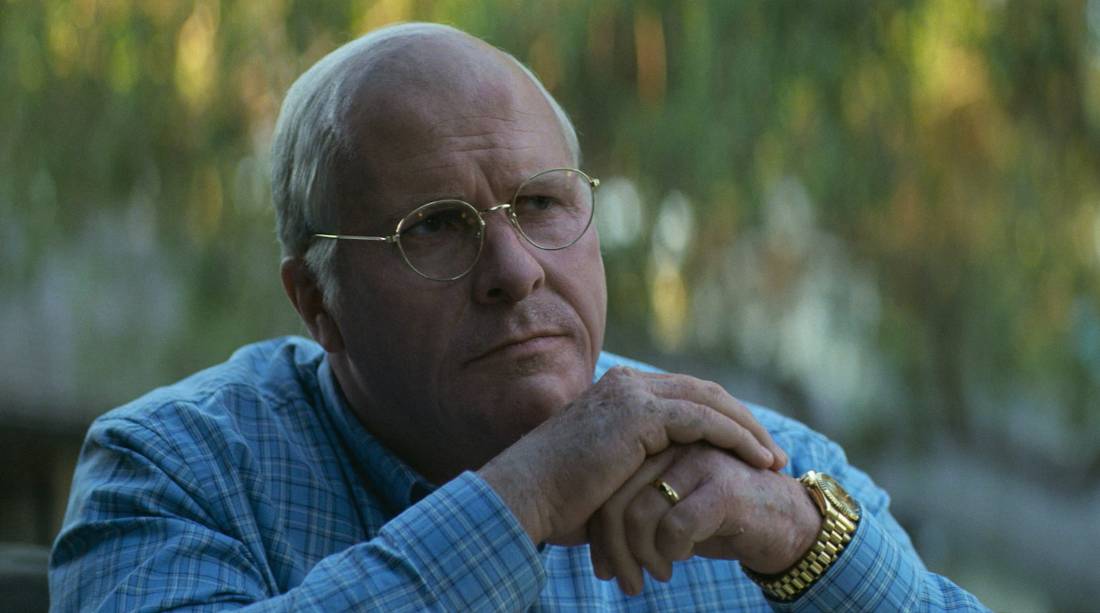
Vice, the latest film by Adam McKay, details how Dick Cheney is undoubtedly one of these people and probably one of the most successful in recent history at pulling off this trick. While Vice-President of the USA between 2001 and 2009, he applied what he had learnt earlier from masters of deception and distraction such as Henry Kissinger in ways that are eerily similar to the actions of the master Russian trickster Vladislav Surkov. He unleashed untold physical and mental destruction on the world, funneled trillions of dollars into the pockets of his friends, acquaintances and fellow travellers, entirely abandoning his duty to confront the catastrophic contemporary problems of human civilisation such as climate change by wielding almost unlimited amounts of executive power.
In order to get away with all of this in the middle of an apparently democratic state with a free press, multi-branch government structure and highly literate citizenry, the film demonstrates how Cheney applied the skills that he had learnt from fly-fishing to make people look exactly where he wanted them to; directly away from his shady shenanigans.
He, like many fishermen before him, knew that if you distract the fish with the right lure, you can make them do absolutely anything. If you construct the lure out of the right material, you can burrow right down into the fish’s natural instinct and trick it into surrendering itself completely; thereby giving itself entirely over to the whims of the fisherman.
This works for humans just the same as it does for fish, you just need to construct your lure out of television, Netflix, video games, shopping centres, alcohol, drugs, food, or sex instead of maggots and feathers.
In other words, vices are not just myriad harmful traps that we as individuals can accidentally fall into, but are also lures that people with power and no morals craftily encourage, promote and facilitate in order to keep us distracted and prevent us from reaching our full potential while they steal and hoard the world’s resources for themselves.
The deliberate destruction of the structures of civilisation by Governments and shady hangers-on in recent years has helped to enable the reemergence of a dark side of the human psyche that many, maybe somewhat naively, had forgotten still remained alive and kicking; fascism.
Except the fascism that we now see all around the world creeping once more out of the deep, dark burrow that many thought it had been consigned is different to the strain that we have seen before.
This time, to dovetail into the culture of our era, it has evolved to leach off a technological host.
Increasingly, people worship material technology while promoting their misguided belief that everything in the universe is simply made from cold, hard atoms.
Technology is the messiah. Numbers are king. Science is God. All Hail! And down with anyone who believes in any wishy-washy social woo-woo nonsense like Art or the study of the ‘humanities’. Everything must be measured and anything that can’t be measured either does not exist or doesn’t matter. The logical endpoint of this ideology is painfully obvious; total nihilism.
When we believe the only thing that exists is the material, any space for something greater, more mysterious or even different evaporates. What then grows in those mental furrows is something very dark indeed.
In today’s world, that darkness is growing.
The problem for men like Dick “heartless” Cheney, the place where their clever little plan comes unstuck, is that the accumulation of power and wealth do not – and ultimately will never – go unnoticed.
Part of the reason for this is that you can’t erase knowledge. If you do something evil, the overwhelming likelihood is that somebody somewhere will have seen you do it and therefore that person has ‘knowledge’ of your evildoing. Now that knowledge, once in existence, is sticky, it hangs around and is almost impossible to erase if you are the evildoer. Sure, knowledge can be forgotten, but that usually takes generations and rarely happens to truly important knowledge. The only other real way to erase knowledge if you are an evildoer is to kill all of those with the knowledge but obviously this then creates yet more knowledge of evildoing and so on ad infinitum.
These men try to hide their loot and attempt to draw a curtain around their power-play but these actions always have wildly unpredictable and chaotic consequences that literally nobody, not even the most powerful supercomputers with their most advanced models, can predict. What this increasing chaos looks like to the outsider is an exponential increase on the ‘crazy-scale’; they can’t figure out why person X is committing actions Y and Z but they sense intuitively that these actions just don’t make sense in a sane, rational world.
Just take a look around you at the kind of things that have been happening over the last few years, the bizarre, ever-more-extreme craziness that is piling up day-by-day. The world, which once felt understandable and within our grasp, today seems increasingly weird and unexplainable.
In this milieu, many develop conspiracy theories in an attempt explain the craziness that they see around them.
The techno-fascists attempt to explain the craziness in the only way that they can (if all you have is a hammer, every problem looks like a nail); using a technological metaphor. They nonchalantly assert that we live inside a simulation controlled by some higher martian cyberlord.
Humans are and always will be exceptionally curious problem-solvers, and therefore our natural reaction to the confusion caused by an elevation of the ‘crazy-scale’ is to double down and try even harder to put the puzzle pieces back together-to try and understand what on earth is going on.
This means that for the lords of darkness to remain hidden behind the curtain, the power of the distraction machine must increase.
However an increase in sensory stimulation for the purposes of distraction can only lead to one inevitable outcome: over-stimulation. People simply can’t take any more. Sure, they’re distracted from the reality of what’s happening around them, but there’s only so much vice we can take. Eventually we will get bored of Netflix, the drugs we take will stop having the effect they once did, the bad food we eat will lose its taste and ability to satisfy us, the things we buy to make us happy will stop doing so, we will begin to crave more than base carnal pleasure.
Our minds and bodies are clever, more than it’s ever possible to know, and will eventually realise that something is not quite right, that things are out of balance and, setting out on the path to re-correct the balance, they will learn to become aware again. Then it’s only a matter of time before the energy currently consumed by vice is once again available to start putting the puzzle pieces back together again.
We do not live inside a machine or a simulation and the natural state of (wo)man is not to seek power or wealth or pleasure, or even happiness; it is to be present and open to the Truth of experience, to learn, grow and day-by-day slowly become a better, more conscious person.
See, there are a few things to remember about the latest and greatest omnishambles-of-doom story/event/problem/crisis that barges its way to the top of the news cycle, onto the tabloid front pages and out of the mouths of bored employees around metaphorical watercoolers – a couple of weeks ago, for a handful of days, it happened to be the seizing of British state power by jester-in-chief Boris Johnson under the desperate guise of a democratic election but next week, and next month it will be something else entirely. Things happen fast these days and it’s easy to become overwhelmed by the constant barrage of crises that pummel us with near-timetabled frequency.
The important things to remember about these narrative-shaping events are;
Peace
 Fractalis - An ongoing journal