Favourite Photos #3

1941 | John Collier

This picture was taken on the world famous main concourse of Grand Central Terminal in New York. Click the image for a high res version.

I love how everybody in the photo is standing still except for the female figure in the middle who seems to be traversing the concourse with a sense of purpose while also exuding an air of mystery.

I guess it goes without saying, but I feel the man who created Grand Central’s cathedral-like architecture also deserves some of the credit for the beauty of this photo. Mr Whitney Warren, I salute you.

Blind Willie Johnson

The life of a blues musician in 1920’s America was notoriously wrought with hardship and poverty. Blind Willie Johnson however may just have had it harder than the rest.

Willie Johnson wasn’t born blind but as his moniker suggests, by the time that he started writing music he had lost his sight in a horrific ordeal. As the story goes, his stepmother was beaten by Willie’s father one night after being caught with another man. She then reacted by throwing lye into Willie’s face leaving him permanently blind.
Not much is known about the life of Blind Willie but we can be fairly sure that he remained poor for most of it, regularly busking in order to collect enough money to survive. In the early 20th century, America was still extremely hostile to black people and Willie turned to the church to find solace from the hardships of daily Texan life. This can be heard in many of his surviving songs which contain a deeply spiritual tone. The songs that Willie recorded during the 20’s and 30’s are extremely haunting but they also have a strangely uplifting quality to them.

In 1945, tragedy struck Blind Willie Johnson’s life for the final time when his house burnt to the ground and having nowhere else to go, he took to sleeping on a pile of damp newspapers in the ruins. This led to him contracting Malaria in the hot Texan weather and dying within weeks. At the time of his death, Willie would have no idea that his music would go on to shape the Blues genre and therefore indirectly influence much of the music produced in the last 50 years. Perhaps his greatest legacy is the inclusion of the above track onboard the Voyager spacecraft in 1977 as an example to Alien lifeforms of Human achievement. By now, Voyager 1 will have exited the solar system over 18 billion kilometres from Earth and therefore acts as the perfect metaphor for the infinite reach of Blind Willie’s music.
Blind Willie Johnson is just one of a number of truly brilliant Blues musicians and Blues as a genre is just one small piece in the rich tapestry of staggering musical achievement, but there is something truly special about Blind Willie’s music. Some timeless, powerful force that speaks through the ages about the pain and suffering of mankind and as long as talented musicians continue to be influenced by his incredible music, as long as Voyager 1 continues through space carrying “Dark Was the Night…”, Blind Willie Johnson will live on.

Favourite Photos #2

1990 | NASA – Pale Blue Dot

This photo, dubbed the “Pale Blue Dot” by Carl Sagan, was taken in 1990 as the Voyager 1 spacecraft exited the solar system after a 12 year mission exploring its far reaches. Travelling at 64,000 km/h and at a record distance of 6 billion kilometres from Earth, the probe had completed its primary mission and was therefore at the disposal of NASA scientists when on Valentines Day 1990 Carl Sagan, one of the greatest scientists of all time who worked as an advisor to NASA, suggested that Voyager 1 be turned around to face Earth in order to get a photograph at this unimaginable distance.

The result is the photograph above which shows Earth as a minuscule dot in the centre of the brown band on the far right. The great thing about the photo is how it shows the true insignificance of the planet we call home. I think we need photos like this to remind us that we aren’t as important as we sometimes like to think we are on this tiny rock in the middle of nowhere.

Favourite Photos #1

1864 | George N. Barnard

This is a photograph of a view from the Capitol in Nashville, Tennessee during the American Civil War in 1864. Click the image for a high res version.

I love the atmosphere of this photo. It reminds me of that feeling you get when you go outside just after it’s rained heavily and you’re all dry but the streets are soaking wet. I also love the way the man almost seems like one of the statues, frozen in time.

The photo is from a website called Shorpy which is absolutely amazing and I highly recommend taking a gander. It contains a huge archive of photographs mostly taken in the USA between 1850 and 1950. More are added every day and the best thing about the site is that all of the images can be viewed in super high resolution which is extremely rare for vintage photographs.

Boardwalk Empire: A Hint of Coen

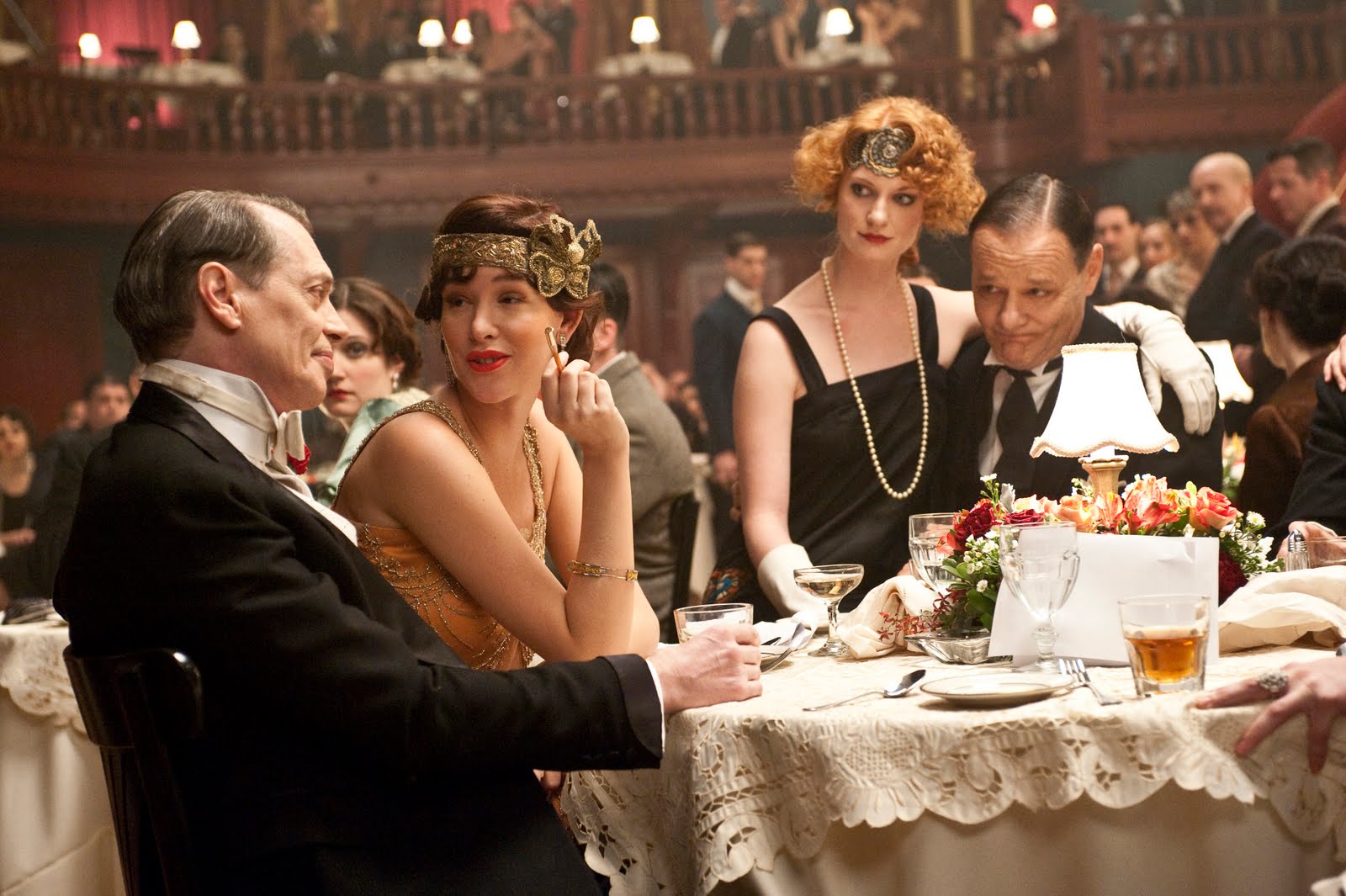
Boardwalk Empire is the latest in a magnificent line of long-running HBO series’. It is currently in its third season and contrary to my initial prediction, is getting better and better as it rumbles on. The show is set on the East Coast of the US in the 20’s/30’s and centres around the effect that the Prohibition has on a variety of characters, both real and fictional.

There are many things that make me keep watching the series including the fantastic quality of the acting. From Steve Buscemi as Nookie Thompson based on the infamous politician Enoch L. Johnson to Michael Stuhlbarg as high class gangster Arnold Rothstein, there is a huge amount of acting talent in Boardwalk Empire. I also can’t get enough of the fantastic noir feel of the series which manages to maintain a vivid colour palette while still providing that beautifully dark noir tone. I feel that my love for 1920’s America may have something to do with my admiration of the series though as it is simply bursting with 20’s music, fashion, architecture and cars.

One thing that is becoming more and more apparent as the show continues however is it’s startling closeness to the artistic style of the Coen Brothers. From the pitch-black comedy we’re used to from films such as Fargo to the philosophically-rich dialogue that runs through most of the Coen’s work, the more I watch Boardwalk Empire, the more it seems like one super long Coen Brothers Masterpiece.

Even the actors wouldn’t be out of place in a Coen Brothers film, with Steve Buscemi being a particular favourite of the Brothers, starring in five of their films. Stephen Root is also a series regular who has starred in three Coen Films as well as Michael Stuhlbarg and Kelly Macdonald who have each appeared in a single Coen film.

I’m not sure of the reason for these apparent stylistic similarities. I can’t seem to find any serious link between the Coen Brothers and Boardwalk Empire, so either a large number of the cast and crew are Coen Brothers fans or my Coen obsessed mind is seeing stylistic similarities which aren’t really there. Maybe it’s a combination of the two. Either way, Boardwalk Empire is, in my opinion, rapidly approaching the dizzy heights of its legendary HBO cousins. Will we eventually be mentioning it in the same sentence as The Wire and The Sopranos? Only time will tell. In the meantime, soak up this Coen-esque delight, you won’t regret it.

Samsara and the Cyclical Nature of Reality

Let me start by saying that Samsara, like so many other documentary films in recent years, is an amazing experience. It has its roots in Baraka, director Ron Fricke’s previous all-encompasing exploration of life, the universe and everything, but it’s real roots lie in the 1982 film Koyaanisqatsi for which Fricke was the cinematographer.

In my opinion Koyaanisqatsi is one of the greatest documentary films ever made, if not one of the greatest of all genres. It provides a mesmerising collection of moving images, cut together expertly into a montage of flowing beauty to convey ideas about the perils of over-consumption, un-sustainability and the misuse of technology. However I believe there are two key things that set Koyaanisqatsi apart from most other films. Firstly, the score written by Phillip Glass is one of the most original pieces of music I have ever heard and fits perfectly with the images on screen. Secondly, the cinematography in every single shot of the film is perfectly captured and oozes pure beauty thanks to Ron Fricke’s expert skill.

This brings us onto Samsara which Fricke directed as well as shot and edited. Although I believe it doesn’t quite reach the mountainous heights of Koyaanisqatsi, I still think it is an incredible film which explores a number of interesting ideas. I want to talk about one idea in particular that the film portrays and which really resonated with me: the cyclical nature of reality.

Samsara (which itself translates from Sanskrit to “continuous flow”) has strong themes of flowing cycles, rebirth and construction/destruction running through it. For example, the film juxtaposes some of civilisations tallest buildings and most advanced pieces of engineering with shots of upturned cars and damaged houses. The film doesn’t show what caused this damage, but like so many other parts of the film, it is clearly trying to show that what rises up in glory must at some point fall with a whimper. I.e. the only constant in the universe is change.
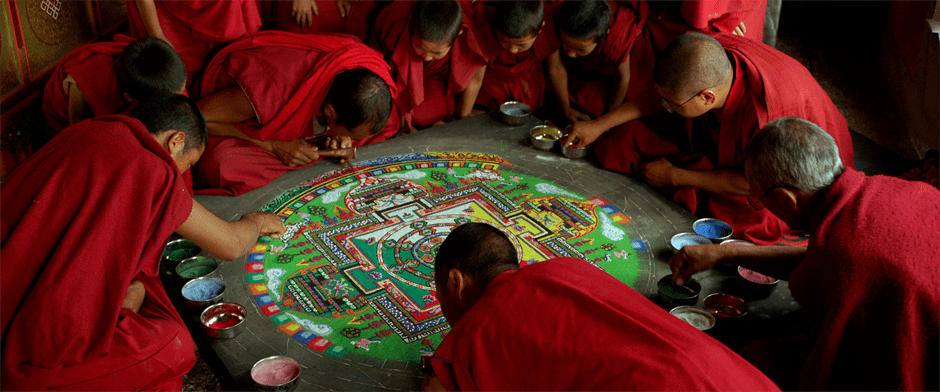
One striking scene in the film shows a group of Buddhist Monks painstakingly building a sand mandala. Mandalas have huge spiritual significance in Eastern religions with the word itself roughly translating to “circle”. The shot lingers for a long time on the intricate detail of the mandala and extreme close-ups almost show individual grains of sand being placed to form part of the brilliant whole. Later in the film, we return to find the Monks destroying the beautifully symmetrical work that they had evidently put so much time into. Once again, we see the idea that what is created must be destroyed to maintain the cyclical harmony of nature.

You don’t have to look far to find evidence of the cyclical nature of reality. The atoms that make up every single cell in our body will one day disassemble and go on to form something or someone else. The sun will rise tomorrow morning and then set the following evening. The seasons will continue to change year after year. The water that falls as rain will find it’s way down a river to the sea, back up to the sky and then begin it’s journey once again. Thanks to the wonders of quantum mechanics applied to the field of microscopy, we can now even show that single molecules such as benzene have a cyclic structure (see image below).

Then we come to the realm of the philosophical and spiritual. If such vital natural systems as the water cycle and carbon cycle have a cyclical nature, is it really that much of a stretch to suggest that consciousness itself is cyclical? Of course religions have preached the ideas of “rebirth” and “afterlife” for millennia but science is still no closer to finding definitive proof of the cyclical nature of life. There are also credible theories that suggest the Big Bang is simply one portion of a cyclical whole which consists of an endless stream of expansion and contraction of the Universe.

It is important to realise in a society so obsessed with improvement, growth, efficiency and heading in one single direction (namely up) that so much of reality is in fact cyclical. What goes up, must come down. What goes around, comes back around.

Samsara. Watch it and stare in awe at the beauty of the cyclical reality within which we find ourselves intimately woven.