Every second around 500 million tons of hydrogen is fused into helium inside the centre of the sun, creating temperatures of up to 15 million degrees and producing enough energy in the form of gamma rays to meet the current global energy demand 25 trillion times over. The gamma rays then commence their journey to the surface of the sun which can take tens of thousands of years. Once they reach the surface, the gamma rays have lost enough energy to become visible light and it takes just 8 minutes for them to reach Earth, bathing is in beautiful sunlight. All of the energy we use has reached Earth this way and therefore life itself is directly dependent on this process know as nuclear fusion inside the core of the sun.
We live in uncertain times. This is never more evident than when looking at the World’s energy supply and rates of consumption. As the population increases to staggering levels over the coming decades, demand for energy will sky rocket. Fossil fuels are running out and their use must be curbed anyway if we want to limit the devastating impact of climate change. Power from nuclear fission has it’s benefits in a post-carbon energy supply but also has a number of significant drawbacks. Renewable sources such as solar, wind, wave and geothermal are fantastic ways to generate energy but can’t be relied upon to solve our energy needs in the short term. Therefore, if we are going to meet the huge energy demands of future generations, there is only one option: carrying out nuclear fusion here on earth.
Nuclear fusion has the potential to create huge amounts of electricity. The key raw material needed for fusion is lithium which can be found, amongst other places, in sea water. It is estimated that all of the sea water on Earth contains around 230 billion tonnes of lithium which would be enough to meet the current global electricity demand for a staggering 60 million years. Even more astounding is if a slightly different fusion reaction was carried out that does not require lithium but instead solely uses the hydrogen isotope deuterium, the sea water on Earth contains enough fuel to meet the current global electricity demand for 150 billion years! That’s 30 times longer than the projected remaining life of the sun.
Like nuclear fission, fusion also releases no carbon dioxide into the atmosphere which is crucial in the coming decades in order to limit the effects of climate change. Another major advantage of nuclear fusion is the lack of any long lasting radioactive waste. Whereas fission produces waste that remains dangerous for thousands of years, the waste produced by fusion only remains dangerous for around 50 years and is therefore much easier to control.
Due to the extremely high temperatures required to carry out fusion, there is also no chance of a meltdown accident occurring as any loss of power to the reactor would simply result in the temperature rapidly decreasing and any fusion reactions automatically stopping.
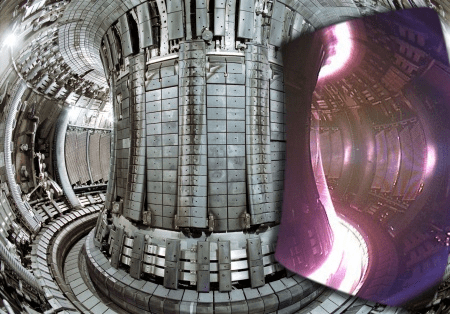
Maintaining nuclear fusion reactions here on Earth is a huge engineering challenge but if it can be achieved it will truly put an end to all of our energy worries and is therefore of paramount importance. Just remember, there is a clean, safe and plentiful alternative to burning fossil fuels and it could be producing our electricity sooner than you think.
 Fractalis - An ongoing journal