
Let me start by saying that Samsara, like so many other documentary films in recent years, is an amazing experience. It has its roots in Baraka, director Ron Fricke’s previous all-encompasing exploration of life, the universe and everything, but it’s real roots lie in the 1982 film Koyaanisqatsi for which Fricke was the cinematographer.
In my opinion Koyaanisqatsi is one of the greatest documentary films ever made, if not one of the greatest of all genres. It provides a mesmerising collection of moving images, cut together expertly into a montage of flowing beauty to convey ideas about the perils of over-consumption, un-sustainability and the misuse of technology. However I believe there are two key things that set Koyaanisqatsi apart from most other films. Firstly, the score written by Phillip Glass is one of the most original pieces of music I have ever heard and fits perfectly with the images on screen. Secondly, the cinematography in every single shot of the film is perfectly captured and oozes pure beauty thanks to Ron Fricke’s expert skill.
This brings us onto Samsara which Fricke directed as well as shot and edited. Although I believe it doesn’t quite reach the mountainous heights of Koyaanisqatsi, I still think it is an incredible film which explores a number of interesting ideas. I want to talk about one idea in particular that the film portrays and which really resonated with me: the cyclical nature of reality.
Samsara (which itself translates from Sanskrit to “continuous flow”) has strong themes of flowing cycles, rebirth and construction/destruction running through it. For example, the film juxtaposes some of civilisations tallest buildings and most advanced pieces of engineering with shots of upturned cars and damaged houses. The film doesn’t show what caused this damage, but like so many other parts of the film, it is clearly trying to show that what rises up in glory must at some point fall with a whimper. I.e. the only constant in the universe is change.
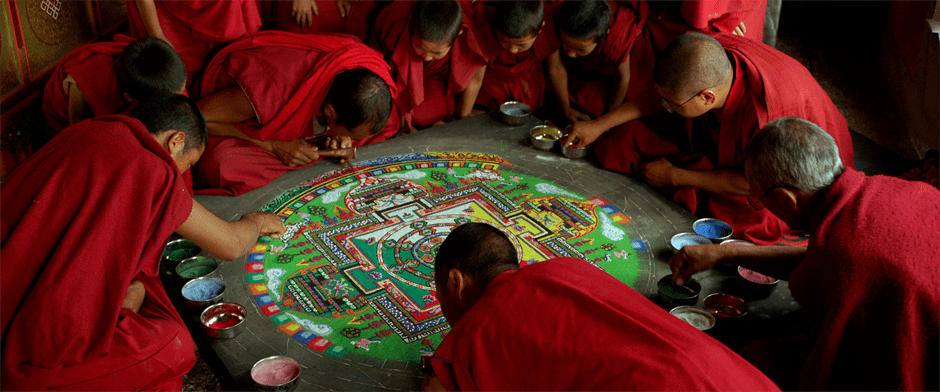
One striking scene in the film shows a group of Buddhist Monks painstakingly building a sand mandala. Mandalas have huge spiritual significance in Eastern religions with the word itself roughly translating to “circle”. The shot lingers for a long time on the intricate detail of the mandala and extreme close-ups almost show individual grains of sand being placed to form part of the brilliant whole. Later in the film, we return to find the Monks destroying the beautifully symmetrical work that they had evidently put so much time into. Once again, we see the idea that what is created must be destroyed to maintain the cyclical harmony of nature.
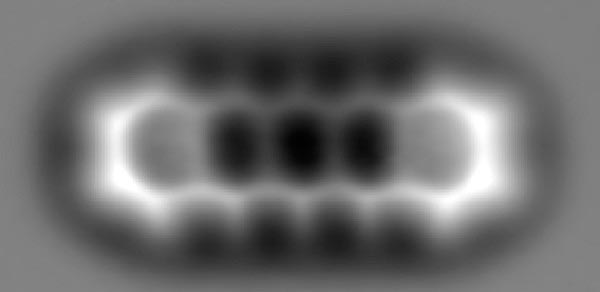
You don’t have to look far to find evidence of the cyclical nature of reality. The atoms that make up every single cell in our body will one day disassemble and go on to form something or someone else. The sun will rise tomorrow morning and then set the following evening. The seasons will continue to change year after year. The water that falls as rain will find it’s way down a river to the sea, back up to the sky and then begin it’s journey once again. Thanks to the wonders of quantum mechanics applied to the field of microscopy, we can now even show that single molecules such as benzene have a cyclic structure (see image below).
Then we come to the realm of the philosophical and spiritual. If such vital natural systems as the water cycle and carbon cycle have a cyclical nature, is it really that much of a stretch to suggest that consciousness itself is cyclical? Of course religions have preached the ideas of “rebirth” and “afterlife” for millennia but science is still no closer to finding definitive proof of the cyclical nature of life. There are also credible theories that suggest the Big Bang is simply one portion of a cyclical whole which consists of an endless stream of expansion and contraction of the Universe.
It is important to realise in a society so obsessed with improvement, growth, efficiency and heading in one single direction (namely up) that so much of reality is in fact cyclical. What goes up, must come down. What goes around, comes back around.
Samsara. Watch it and stare in awe at the beauty of the cyclical reality within which we find ourselves intimately woven.
 Fractalis - An ongoing journal